

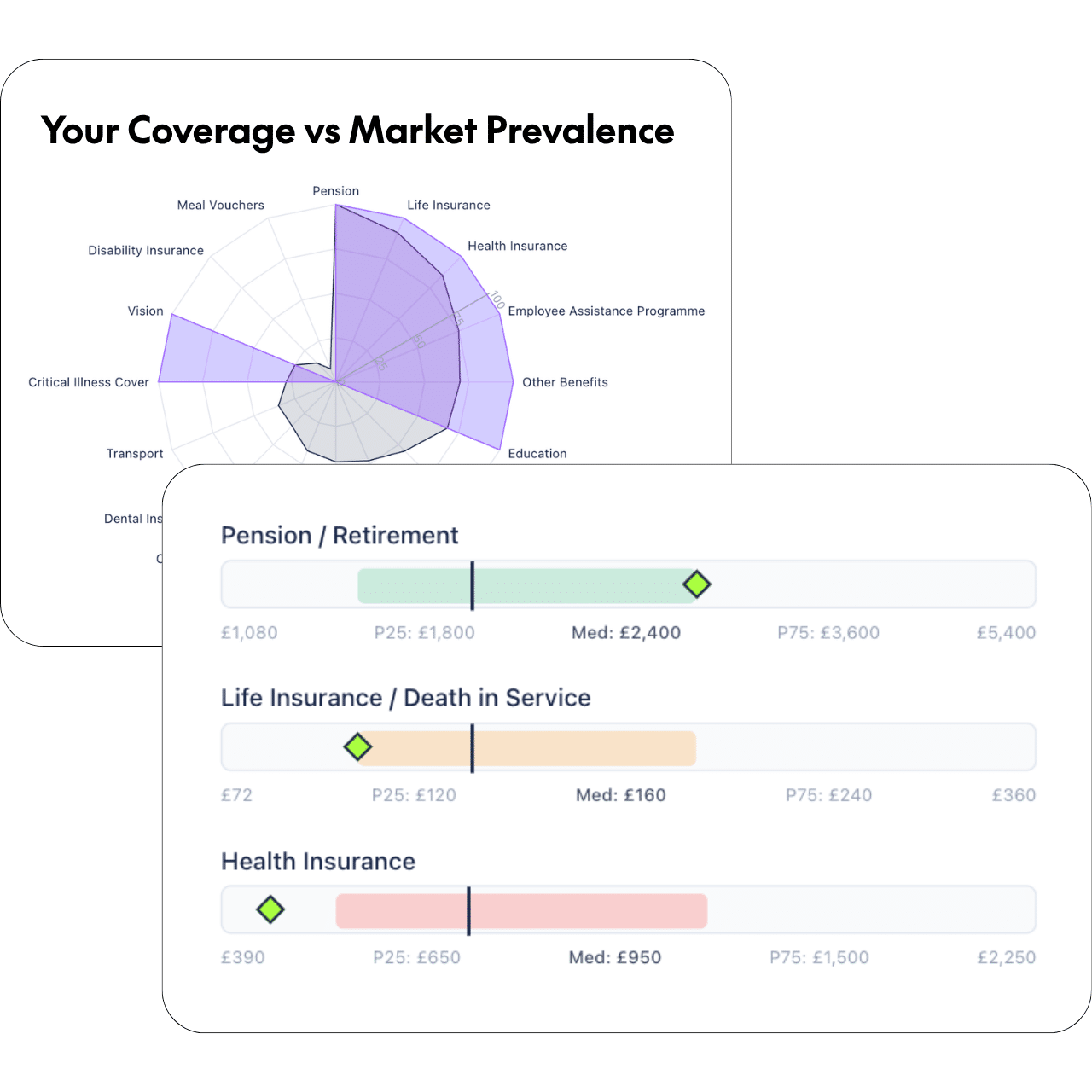

What is benefits benchmarking?
Employee benefits benchmarking is the practice of comparing your organisation’s benefits package from costs, coverage, and design against market data and competitors to see how it stacks up.
It helps HR answer two key questions:
- Are we offering the right benefits at the right cost?
- Are we competitive enough to attract and retain talent?
Benchmarking isn’t just about cheap vs. expensive; it’s about value, alignment with employee needs, and sustainability of your total‑reward budget.
Why benchmarking matters
Labor markets remain tight, and many employees say they would change jobs for better pay and benefits.
- Benchmarking quickly exposes gaps (missing benefits employees really want) and overspends (benefits that are underused or mis‑priced).
- It also provides a data‑backed story for finance and leadership when you propose changes (“We’re under‑market on mental‑health cover” or “Our pension contribution is above‑median, so we’re a strong talent brand”).
Because benefit costs are rising, upwards of 6% YoY, benchmarking helps you protect budgets without cutting in the wrong areas.
What to benchmark in your package
You’d typically want to focus on several layers:
- Health & protection
- Medical insurance, dental, optical, life cover, income protection, critical‑illness schemes.
- Look at: employer contribution %, employee contribution %, deductibles, network breadth.
- Retirement & savings
- Pension contribution levels, matching, auto‑enrolment thresholds, and salary‑sacrifice use.
- Compare against industry‑specific pension reports and total‑reward benchmarks.
- Wellbeing & lifestyle benefits
- Total reward context
- Many guides recommend pairing benefits benchmarking with salary and overall reward data to see the full picture of what employees are paid and receive.
With your global benefits in one place, Eppione’s benchmarking lets you gather this data in minutes and start planning based on the results.
How to run a benefits benchmarking exercise
Most practical frameworks follow a similar six‑step flow:
- Define your goals
- Are you trying to reduce costs, improve retention, or modernise your wellbeing offer? Each goal shapes which data you prioritise.
- Clarify what you’ll measure
- Decide scope: all benefits, health‑only, or wellbeing‑only. Choose metrics (e.g., % of salary spent on benefits, utilisation rates, employee satisfaction scores).
- Pick your comparators
- Focus on organisations of similar size, sector, and location (e.g., EMEA/Ireland, tech vs. professional services).
- Gather data
- Use a mix of:
- Market reports and benchmark studies (country/industry‑specific).
- Internal data: premiums, claims, utilisation, and employee surveys.
- Public data (e.g., filings, employer ratings sites) where available.
- Use a mix of:
- Analyse gaps and opportunities
- Map where you sit vs. median/peers: e.g., “below market on parental leave” or “above‑average on pension but lagging on mental‑health support”.
- Highlight “candidates” for change: benefits to add, reduce, or redesign.
- Communicate and act
- Turn findings into a simple roadmap (e.g., 3‑, 6‑, 12‑month actions) and explain the “why” to employees.
- Announce enhancements clearly so employees see the value; many high‑value benefits are under‑recognised.
Common pitfalls to avoid
- Benchmarking only price
Looking only at premiums without checking design, networks, or employee satisfaction can lead you to pick cheaper but less effective plans. - Comparing the wrong peers
Comparing a 50‑person tech startup with large corporations can mislead budget expectations. Segment by size, geography, and sector. - Ignoring employee feedback
Reports and filings show “what” you offer; employee surveys and Glassdoor‑style reviews show “how it feels”. - One‑off benchmarking
Many employers only benchmark at renewal time. A recurring cadence (e.g., annual or bi‑annual) helps you adapt to cost trends and changing expectations.
How benchmarking feeds into your benefits strategy
The strongest benefits strategies are those that:
- Use benchmark data to design flexible, personalised, and well-being-focused packages.
- Balance cost control with employee experience, especially in high‑cost areas like healthcare and mental‑health services.
By treating benchmarking as a regular, data‑driven discipline, you can move from “hope‑and‑guess” benefits reviews to a structured way of proving value, optimising spend, and strengthening your employer brand.
See Eppione’s Employee Benefits Benchmarking in action


